sexta-feira, 31 de maio de 2019

Food Waste Management Market 2019 Global Key Players, Size, Applications & Growth Opportunities – Analysis to 2025

May 29, 2019 (MarketersMedia via COMTEX) -- Wiseguyreports.Com Publish New Market Research Report On -"Food Waste Management Market - Global Analysis, Size, Share, Trends, Growth and Forecast 2019 - 2025"

Pune, India - May 29, 2019 /MarketersMedia/ --

Food Waste Management Market 2019

Report DescriptionThis report analyzes the global food waste management market by processes (aerobic digestion, anaerobic digestion, combustion and others), by waste type (food production waste, food processing waste, distribution and supply chain waste, retail waste and consumption waste), end use (animal feed, fertilizer, renewable energy & biofuels and others) and region; it also studies the top manufacturers in the market.

The major players in global food waste management market include:? Andritz Ag (Austria)? Waste Management, Inc. (U.S.)? Veolia Environnement S.A. (France)? Republic Services, Inc. (U.S.)? Stericycle, Inc. (U.S.)? Covanta Holding Corporation (U.S.)? Waste Connections, Inc. (Canada)

Request Free Sample Report @ https://www.wiseguyreports.com/sample-request/3944396-food-waste-management-market-research-report-forecast-to-2023

The market revenue and share have been analyzed with respect to the following regions and countries:AmericaNorth AmericaUSCanadaEuropeGermanyFranceItalySpainU.KRest of EuropeAsia PacificChinaIndiaSingaporeAustraliaRest of Asia PacificRest of the WorldBrazilArgentinaSouth AfricaSaudi ArabiaOthers

On the basis of processes, the global food waste management market has been categorized into the following segments:? Aerobic Digestion? Anaerobic Digestion? Combustion? Others

On the basis of waste type, the global food waste management market has been categorized into the following segments:? Food Production Waste? Food Processing Waste? Distribution and Supply Chain Waste? Retail Waste? Consumption Waste

On the basis of end use, the global food waste management market has been categorized into the following segments:? Animal Feed? Fertilizer? Renewable Energy? Biofuels? Others

On the basis of region, the global food waste management market has been categorized into the following segments:? North America? Europe? Asia Pacific? Rest of the World

Complete Report Details @ https://www.wiseguyreports.com/reports/3944396-food-waste-management-market-research-report-forecast-to-2023

Table of Contents -Analysis of Key Points

1 Executive Summary2 Market Introduction3 Research Methodology4 Market Dynamics5 Market Trends6 Market Factor Analysis7 Market By Process Type8 Market By Waste Type9 Market By End Use10 Market By Region11 Competitive Landscape12 Company ProfilesList of Tables and Figures

Continued.....

Also Read: Global Waste Management Software Market Size, Status and Forecast 2022

Contact Info:Name: Norah TrentEmail: Send EmailOrganization: WISE GUY RESEARCH CONSULTANTS PVT LTDAddress: Office No.528,Amanora Chambers,Magarpatta Road,Hadapsar,Pune-411028.Phone: +1-646-845-9349Website: https://www.wiseguyreports.com

Source URL: https://marketersmedia.com/food-waste-management-market-2019-global-key-players-size-applications-growth-opportunities-analysis-to-2025/517969

Source: MarketersMedia

Release ID: 517969

continue reading Food Waste Management Market 2019 Global Key Players, Size, Applications & Growth Opportunities – Analysis to 2025

terça-feira, 28 de maio de 2019

Over 25 States to Pay Rs One Crore as Environment Compensation for Inaction on Plastic Waste Disposal

New Delhi: Over 25 state governments may have to pay environment compensation of Rs one crore each for not submitting their respective action plans on systematic disposal of plastic waste to the Central Pollution Control Board (CPCB) as the April 30 deadline set by the National Green Tribunal has passed by.

The states had to submit action plans by April 30 to the CPCB, failing which they would have to pay the pollution body a compensation at the rate of Rs one crore per month, as per the National Green Tribunal (NGT) order.

Speaking to PTI, S.K. Nigam, former Additional Director of CPCB and the man who took the legal recourse against the erring states, said, “They [states] did not comply with our orders, so we moved the NGT. Now they are violating NGT orders, so they have to pay the price for it. The punishment not just includes compensation but imprisonment too, in some cases.”

Nigam said conditions were poor in terms of plastic and solid waste management rules as states do not prioritise the same. â€œThe state of affairs is poor. Waste management is the last in the list of priorities of municipal corporations. The CPCB will now apprise the NGT about non-compliance and make the states pay heavy amount for the default.”

Explaining the cause of non-compliance by state governments, NGO Indian Pollution Control Association (IPCA) Chairman Ashish Jain said there was a lack of knowledge among state authorities and a communication gap between state and central government officials

“Lack of knowledge and updates among the state pollution control boards is the main reason for non-compliance of plastic waste management rules. There is a communication gap between the ministry of environment and state level officials responsible for waste management compliance. “The ministry of environment needs to conduct awareness programmes to educate state-level officials to carry out necessary measures to segregate plastic and dispose of it,” he said.

Also read: Does the Environment Matter to Indian Voters?

The NGT had earlier this year directed all states and Union territories except Andhra Pradesh, Sikkim, West Bengal and Puducherry to submit an action plan for compliance of PWM Rules and furnish the same to the CPCB by April 30, 2019. â€œIt is made clear that any failure in this regard will result in defaulting states being required to pay compensation to be deposited with the CPCB at the rate of Rs one crore per month after May 1, 2019,” the NGT order had said.

Except Andhra Pradesh, Puducherry, Sikkim and West Bengal, the remaining states/UTs and SPCBs (state pollution control boards) have failed to submit the Action Plan for implementation of various provisions of Plastic Waste Management (PWM) Rules 2016, as amended, 2018 for setting-up of plastic waste management system for collection, segregation and disposal of plastic waste in the cities, towns and villages and registration of plastic units, the NGT had noted.

“Due to this widespread littering, choking of drains, open burning of plastic waste, etc. has been continued,” it had said.

It was also noted that though 22 states â€" Andaman and Nicobar Islands, Arunachal Pradesh, Chandigarh, Chhattisgarh, Daman and Diu, Dadra Nagar Haveli, Delhi (subjudice), Haryana, Himachal Pradesh, Jammu and Kashmir, Jharkhand, Karnataka, Lakshadweep, Madhya Pradesh, Maharashtra, Nagaland, Punjab, Rajasthan, Sikkim, Tamil Nadu, Tripura, UP and Uttarakhand â€" have imposed complete ban on use of plastic carry bags but due to lack of proper regulation, thin carry bags and other plastic products are indiscriminately stocked, sold and used in majority of cities and towns across the country.

“The ban imposed by State/UTs is not effective in a majority of States and UTs, including Delhi. Burning of Plastic waste in cities, towns and villages, including dumping sites is continuing. Huge quantity of plastic waste is littered on railway tracks, bus stations in Delhi and National Capital Region and other cities/towns,” the tribunal had said.

continue reading Over 25 States to Pay Rs One Crore as Environment Compensation for Inaction on Plastic Waste Disposal

segunda-feira, 20 de maio de 2019

This Deal Did Not Go Down The Drain: Waste Management Brings US$4bn Bond To Market

While recent volatility temporarily stymied the U.S. investment-grade corporate bond primary market, issuers have taken advantage of the newfound calm to resume sales.

Among the deals priced Tuesday, Texas-based disposal company Waste Management (NYSE: WM) sold US$4bn worth of 'BBB'-rated bonds in five parts.

The firm said it intends to use the net proceeds from the issuance to help pay for its US$4.9bn purchase of Advanced Disposal Services (NYSE: ADSW) – announced in mid-April – as well as support its tender offering of up to US$1.3bn and repay commercial paper borrowings.

As of May 9, 2019, Waste Management held roughly US$1.2bn of outstanding borrowings under its commercial paper program, with a weighted average interest rate of 2.70%.

Combining forces

The merger, which effectively combines the largest and fourth largest municipal solid waste operators in the U.S., primarily aims to expand Waste Management's footprint and customer base.

Under the terms of the agreement, the environmental solutions company stands to gain Advanced Disposal's more than 3 million residential, commercial, and industrial customers, including over 800 municipalities, primarily in 16 states in the Eastern half of the U.S. Its solid waste network includes 94 collection operations, 73 transfer stations, 41 landfills, and 22 owned or operated recycling facilities.

Waste Management underscored its target's US$1.56bn in 2018 revenues, adjusted EBITDA of US$427m, as well as a workforce of around 6,000 employees.

Jim Fish, Waste Management's CEO, said that with this acquisition, "we will grow our asset footprint to serve more customers and communities and generate significant growth and value creation opportunities for Waste Management's shareholders and our combined company's employee base.

"Waste Management's disciplined capital allocation and balance sheet strength position us well to execute upon this unique opportunity to expand our scale and capabilities to serve an even broader customer base and realize the strategic and financial benefits the acquisition of Advanced Disposal creates."

The transaction is expected to close by the first quarter of 2020, and, if successful, Waste Management expects to maintain its investment-grade credit profile, with a pro-forma leverage ratio within its long-term targeted net debt-to-EBITDA range of 2.75x to 3.0x.

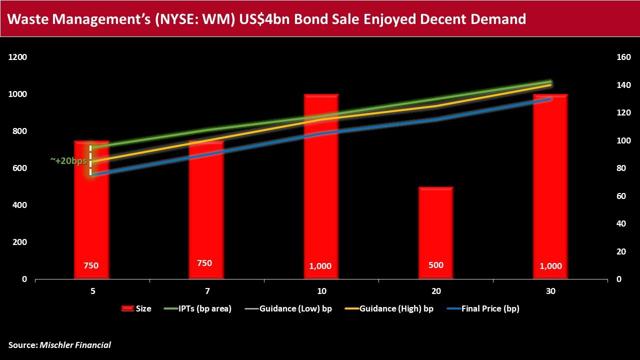
Fitch Ratings assigned a 'BBB+' rating to the US$4bn senior unsecured note sale, which was comprised of tenors of five, seven, 10, 20 and 30 years.

Fitch analysts Carlos Benedict and Stephen Brown noted that while the tie-up will "substantially" increase Waste Management's debt burden, it expects the company to use its "strong" free cash flow (NYSE:FCF) to reduce leverage over the 12 months following the acquisition close.

Fitch expects adjusted debt/EBITDAR and FFO adjusted leverage to fall below 3.0x and 3.5x, respectively, within a year of the transaction.

Fitch said that although it expects the company will prioritize debt reduction over the intermediate-term, the "incremental leverage will reduce headroom in the rating, and any further debt-funded acquisition activity or a decision by the company to prioritize share repurchases over de-levering could result in a negative rating action."

The US$4bn note deal was co-lead managed by Credit Suisse, Deutsche Bank Securities, Goldman Sachs, J.P. Morgan and Mizuho Securities.

Demand remains ripe

Meanwhile, demand for the issuance was generally fervent, with spread compression of around 12.5 basis points to 20bps across the tranches. Most of bond investors' interest appears to have been focused on the deal's five-year notes, which priced at a spread of 75bps more than matched-maturity U.S. government debt – a narrowing of 20bps from its initial price talk.

Overall, Waste Management's issuance contributed to seven investment-grade corporate bond sales Tuesday, totaling US$10.4bn, according to figures compiled by Ron Quigley, head of fixed income syndicate at Mischler Financial. It fell alongside other iconic industrial names such as Caterpillar Financial (NYSE: CAT), which sold a US$2bn bond in three parts.

Quigley added that the company's sale accounted for nearly 40% of Tuesday's volume "post-positive Trump comments that a trade war deal can still be hammered out between the U.S. and China," which helped ease market tensions.

Indeed, high grade corporate debt continues to attract global demand for the yield offered in the primary market – especially among those bond buyers who have been priced out of their local markets or have a dearth of available paper.

The yields on 10-year Japanese and German government bonds, for example, were last in the areas of -0.065% and -0.100%, respectively.

Fund flows also continue to swell.

For the week ended May 8, Thomson Reuters/Lipper U.S. Fund Flows reported a net inflow of roughly US$3.33bn into investment-grade corporate bond funds, while high yield funds posted net outflows of just US$212m.

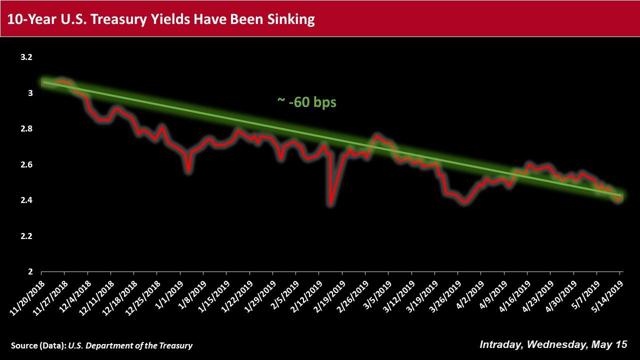
Secondary performance of certain high-grade notes has also been on the upswing, as U.S. Treasury yields have fallen recently.

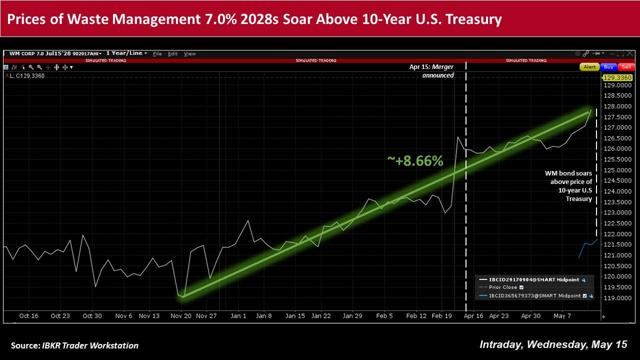
Prices of Waste Management's 7.0% notes due July 15, 2028, for example, have risen about 8.66% from its 52-week low set in late November 2018 to a new one-year high of US$129.336 intraday Wednesday, according to the IBKR Trader Workstation. Over that period, the yield on the 10-year U.S. Treasury note has fallen by almost 70bps. That note was last trading at around 2.38% intraday Wednesday.

While geopolitical tensions and fears of slowing global growth have generally helped prices of U.S Treasuries to rise, the Federal Reserve's recent decisions to maintain the target range for the federal funds rate at 2.25-2.5%, with no plans in 2019 to hike interest rates further, as well as cease other quantitative tightening measures, have also spurred a plunge in government bond yields, which effectively helped to reignite a decent degree of risk appetite amid lower borrowing costs.

Note: This material was originally published on IBKR Traders' Insight on May 15, 2019.

The analysis in this material is provided for information only and is not and should not be construed as an offer to sell or the solicitation of an offer to buy any security. To the extent that this material discusses general market activity, industry or sector trends or other broad-based economic or political conditions, it should not be construed as research or investment advice. To the extent that it includes references to specific securities, commodities, currencies, or other instruments, those references do not constitute a recommendation by IBKR to buy, sell or hold such investments. This material does not and is not intended to take into account the particular financial conditions, investment objectives or requirements of individual customers. Before acting on this material, you should consider whether it is suitable for your particular circumstances and, as necessary, seek professional advice.

Disclosure: I/we have no positions in any stocks mentioned, and no plans to initiate any positions within the next 72 hours. Business relationship disclosure: I am receiving compensation from my employer to produce this material.

continue reading This Deal Did Not Go Down The Drain: Waste Management Brings US$4bn Bond To Market

Waste To Energy Market Key Factor Analysis of Waste Management Inc., Covanta Energy Corp, C And G Environmental Protection Holdings Ltd

May 16, 2019 (Heraldkeeper via COMTEX) -- Waste To Energy Market valued approximately USD 28 billion in 2017 is anticipated to grow with a healthy growth rate of more than 5.10 % over the forecast period 2018-2025. Waste to energy involves processing municipal solid waste into heat, electricity, and refuse derived fuel . The concept has superseded the 'garbage in - garbage out' practice by facilitating efficient garbage management while simultaneously providing clean energy and deriving dollars out of waste.

The waste to energy market is expected to witness significant growth over the forecast period. Increasing demand for renewable sources is anticipated to propel the global waste to energy market over the forecast period. A shift in focus towards substitutes such as coal with renewable resources to reduce carbon content is also projected to play a vital role in shaping the industry. Increasing domestic and industrial waste has prompted governments across various regions to promote energy generation from waste. Favorable government regulations in the form of tax benefits and financial incentives have had a positive influence on the growth. Growing environmental concerns for the use of non-renewable resources is expected to further complement the growth.

Get Sample Copy of this Report at https://brandessenceresearch.biz/Request/Sample?ResearchPostId=437&RequestType=Sample

The regional analysis of Global Waste To Energy Market is considered for the key regions such as Asia Pacific, North America, Europe, Latin America and Rest of the World. Europe market led the global industry in 2017, The region is projected to grow at a CAGR of around 6% over the forecast period. Stringent regulations to minimize the industrial waste is expected to boost the growth in the region. Countries such as Germany, Austria and Netherlands have adopted WTE technologies to utilize industrial waste. Asia Pacific is projected to account for the second largest share of the market. China and India carry a huge potential for growth owing to increasing industrial and residential waste. Rapid industrialization coupled with growing importance for renewable energy generation is expected to drive the regional growth over the forecast period.

The objective of the study is to define market sizes of different segments & countries in recent years and to forecast the values to the coming eight years. The report is designed to incorporate both qualitative and quantitative aspects of the industry within each of the regions and countries involved in the study. Furthermore, the report also caters the detailed information about the crucial aspects such as driving factors & challenges which will define the future growth of the market. Additionally, the report shall also incorporate available opportunities in micro markets for stakeholders to invest along with the detailed analysis of competitive landscape and product offerings of key players. The detailed segments and sub-segment of the market are explained below:

Browse The Full Report @ https://brandessenceresearch.biz/Energy-and-Mining/Waste-To-Energy-Market/Summary

Waste To Energy Market Segmentation

By Technology:

ThermalBiological

By Regions:

North AmericaU.S.CanadaEuropeUKGermanyAsia PacificChinaIndiaJapanLatin AmericaBrazilMexicoRest of the World

The industry is seeming to be fairly competitive. Some of the leading market players include Abu Dhabi National Energy Company PJSC, Waste Management Inc., Covanta Energy Corp, C&G Environmental Protection Holdings Ltd, Foster Wheeler A.G, Constructions Industrielles de la Mediterranee, China Everbright International Ltd., Veolia Environment S.A., Babcock & Wilcox Enterprises, Inc, Xcel Energy Inc.and so on. Acquisitions and effective mergers are some of the strategies adopted by the key manufacturers. New product launches and continuous technological innovations are the key strategies adopted by the major players.

TABLE OF CONTENTS

Chapter 1. Global Waste To Energy Market Definition and Scope

1.1. Research Objective1.2. Market Definition1.3. Scope of The Study1.4. Years Considered for The Study1.5. Currency Conversion Rates1.6. Report Limitation

Chapter 2. Research Methodology

2.1. Research Process2.1.1. Data Mining2.1.2. Analysis2.1.3. Market Estimation2.1.4. Validation2.1.5. Publishing2.2. Research Assumption

Chapter 3. Executive Summary

3.1. Global & Segmental Market Estimates & Forecasts, 2015-2025 (USD Billion)3.2. Key TrendsChapter 4. Global Waste To Energy Market Dynamics4.1. Growth Prospects4.1.1. Drivers4.1.2. Restraints4.1.3. Opportunities4.2. Industry Analysis4.2.1. Porter's 5 Force Model4.2.2. PEST Analysis4.2.3. Value Chain Analysis4.3. Analyst Recommendation & Conclusion

Chapter 5. Global Waste To Energy Market, By Technology

5.1. Market Snapshot5.2. Market Performance – Potential Model5.3. Global Waste To Energy Market, Sub Segment Analysis5.3.1. Thermal5.3.1.1. Market estimates & forecasts, 2015-2025 (USD Billion)5.3.1.2. Regional breakdown estimates & forecasts, 2015-2025 (USD Billion)5.3.2. Biological5.3.2.1. Market estimates & forecasts, 2015-2025 (USD Billion)5.3.2.2. Regional breakdown estimates & forecasts, 2015-2025 (USD Billion)

Continue…

Get Full TOC @ https://brandessenceresearch.biz/Energy-and-Mining/Waste-To-Energy-Market/toc

About us

As a leading market research reseller, we help businesses exploit market intelligence and leverage the in-depth analysis of market research to devise strategies in a competitive market. Our expertise in business domains helps us to curate and aggregate market research reports that offer a laser-like focus on the targeted segments. A slice of the market share is a hard won battle, and it takes the power of actionable insights to help businesses take timely decisions. The 'need of the hour' is inputs that are relevant and on time.

Contact UsAlan RufalloBusiness Development ManagerTel: +44-2038074155 / +91-7447409162Email: alan@brandessenceresearch.comWebsite: www.brandessenceresearch.biz

continue reading Waste To Energy Market Key Factor Analysis of Waste Management Inc., Covanta Energy Corp, C And G Environmental Protection Holdings Ltd

sábado, 18 de maio de 2019

Nuclear Waste Disposal -- Isn't Science Supposed To Reduce The Uncertainty?

The Yucca Mountain site was chosen in 1987 to be the first of two high level and spent nuclear fuel repositories in America, but the basis for the final decision was quite political, causing large uncertainties in the performance and the cost.

DOE

One of science's strongest abilities is to be able to reduce uncertainties in a problem.

If left to itself, science usually does this very well. But it's rarely left to itself. Science exists within the larger framework of society and has to deal with the realities of politics, economics, history and even religion.

Nowhere is this more obvious then with nuclear waste disposal. For this problem, the question we want to know with a fair degree of certainty is:

If we put nuclear waste in this spot, what's likely to happen to it in 10,000 or 100,000 years? Will it contaminate the environment before it decays away? What are the risks to humans and the ecosphere?

Unfortunately, even though we in the scientific community have answered these questions pretty well, our nuclear waste program is presently in shambles.

To recap nuclear waste history, America's nuclear waste program began during WWII and the making of the Bomb. The production and reprocessing of fuel from weapons reactors to make Pu resulted in the first significant amount of nuclear waste beginning in 1944.

With the increasing frenzy of weapons production, and the advent of commercial power reactors in the 1950s, from which you can't make weapons, it became obvious that we needed a place to put this stuff away.

The federal government asked the National Academy of Sciences (NAS) to come up with the best strategy and, in 1957, they reported that deep geologic disposal (half-a-mile or so below the Earth's surface) was best. And they had a particular rock in mind, called massive Permian salt, which is the best rock for isolating anything - forever. And a rock that America has a lot of.

This recommendation led directly to the only operating deep geologic repository in the world, the Waste Isolation Pilot Plant (WIPP) in New Mexico. A splinter strategy in the 1970s, involving retrievability of spent nuclear fuel from the depths, then led to the 1982 Nuclear Waste Policy Act (NWPA) and its 1987 Amendment that chose Yucca Mountain, mainly by political means, as the only repository for spent nuclear fuel (SNF) and high-level waste (HLW). The State of Nevada has fought that decision ever since.

We submitted a license application for Yucca Mt in 2008, but in 2009, the Obama Administration terminated the project and formed the Blue Ribbon Commission (BRC) to recommend alternative paths.

(Full disclosure, I was one of the original authors of the Yucca Mt License Application – very proud of the work we did over two decades)

Meanwhile, WIPP continued on in the salt, with its license and permit curtailed to include only transuranic waste (TRU), the other type of nuclear bomb waste, that is mainly Pu, U, Am and other actinide elements along with other nasties.

Periodically, attempts are made to resuscitate the Yucca Mt. project, as is being done once again as of this writing.

A Rock With Only Little Uncertainty

The ultimate basis for any choice of rock and location is to maximize properties you think are good, and minimize properties you think are bad. The best way to do this is to use natural systems that have already minimized these uncertainties by minimizing or eliminating the properties themselves. Pick a site where almost nothing has been happening for a long time, and where almost nothing will happen in the future.

This is WIPP - few uncertainties.

The Salado Salt formation that hosts the WIPP site was chosen originally based entirely on science by the NAS. It was designed and built for all nuclear waste from any source, but later was licensed and permitted only for transuranic waste as the decision on Yucca Mt reduced its mission – for now. Its choice caused few uncertainties.

DOE

Alternatively, you can try to impose certainty on the system through engineering. Unfortunately, the Earth is a large, active and open system that resists control by human engineering schemes and our understanding and control of these processes has always been limited.

Yes, the Pyramids are fantastic but that's about all humans have made that has lasted anywhere near what we think of as geologic time, and what we need for long-term safe disposal of nuclear waste.

This is Yucca Mountain - many uncertainties.

There are many factors and properties of a situation that contribute to risk. For geologic containment, the most important properties are the characteristics of the rock itself, especially the permeability, chemical composition, strength, thermal conductivity, density, porosity, and porewater chemistry. Another key element includes the climate of a particular place and time.

Therefore, the best way to reduce uncertainty is to pick a situation that has few variables or where those variables have values approaching zero, which is what the NAS did when they chose Permian Salt. The Atomic Energy Commission, and later the Department of Energy, searched for a suitable site in Permian Salt and, after several failed attempts, was invited by the local community in Carlsbad, New Mexico to investigate their proposed site.

Carlsbad was settled in the 1880s by German miners mining salt above what is the most optimal rock in the United States - the massive Permian Salado Salt formation. The miners and geologists in Carlsbad understood the engineering needs of the nuclear repository better than the DOE, and understood that the Salado Salt Formation outside of Carlsbad would provide all of the performance required even without any engineered barriers.

The Waste Isolation Pilot Project (WIPP) repository was sited in the Delaware sub-basin of the Permian salt in southeast New Mexico and West Texas. It was designed and built for all nuclear waste of any type. Later, after the 1982 NWPA, WIPP was licensed and permitted only for transuranic nuclear weapons waste.

WIPP is just one place that has ideal massive salt deposits. Although the following discussion uses data from the Salado Salt at the WIPP site, we have well over 100,000 square miles of appropriate massive salt deposits in America with similar optimal rock properties that would suffice for nuclear waste disposal.

One particularly important property of massive salt is something called creep closure. At depth, under the pressure of the overlying rocks, the salt cannot maintain an opening, fracture or pore space. It's why the salt is essentially impermeable, e.g., the trapped water in the salt hasn't migrated an inch in 270 million years.

The permeability of water, or the hydraulic conductivity, is less than 10-14 cm/s, and the aqueous diffusion coefficient is less than 10-15 cm/s2, amazingly low values that are, for all practical purposes, zero. Water just won't move in this rock.

The redox potential of the pore water in this salt is exceptionally reducing, one of the most reducing in the country, with Eh values (oxidation potential) less than -500 mV. This makes redox-sensitive radionuclides such as Pu, U, Tc, Np, Se, and I, immobile and unlikely to migrate out of the repository in the highly unlikely event that there is a path out.

Which is unlikely in the extreme. If a fracture does occur in the salt, or if we dig out an opening to put waste in, the salt creeps closed over a relatively short time, tens of years. It naturally recompacts so there is no open space and the salt becomes essentially impermeable again.

In fact, any disturbance in rock properties from a cut only goes out about 14 feet from the wall of the repository anyway. Beyond that, the rock isn't even disturbed. And these formations are thousands of feet thick. At WIPP, the Salado salt formation is 2000 feet thick over an area of 10,000 square miles.

Two of those square miles could hold all of the waste destined for Yucca Mountain. WIPP already has more nuclear waste by volume than everything that was supposed to go into Yucca Mountain, some of it as radioactive as high-level waste.

In addition, the Salado Salt Formation in this region has never been subjected to any adverse geological processes – no volcanism, no folding or faulting, not even any tilting after 270 million years, quite unusual. There was only some regional uplift. In fact, this area is tectonically the quietest region in America and will be for the next 200 million years.

Which is why the National Academy of Sciences picked this rock in the first place. All the adverse properties and possible processes are either practically zero or non-existent. Which means the uncertainties are few and small, and come mainly from the mining operation or future human activities that we can never predict or control. The NAS recommendation for a salt host rock still stands and, in fact, has been borne out by 19 years of successful WIPP operations.

A Rock With Lots of Uncertainty

The other way to address uncertainty is to deal with each uncertain variable separately and try to force them to become practically zero through human engineering. The Yucca Mountain Project tried this, beginning in 1982, by hoping variables that cropped up were sufficiently minor that they could be handled by changing the design as we discovered them.

Instead, what we did was just add more variables with bigger uncertainties. We addressed many by testing and redesigning over the years between 1987 and 2000, or finding new information, but the uncertainties just grew. As did the projected cost.

The host rock for the Yucca Mountain repository, the Topapah Spring tuff, is a highly fractured, dual porosity, and variably saturated volcanic rock with highly oxidizing pore water, that sits along the edge of a tectonically-active region called the Las Vegas Shear Zone in which the Mojave Block is being rotated between the San Andreas fault along the south and the Garlock Fault along the north.

The permeability of water, or hydraulic conductivity, varies from 10-10 cm/s to 10-4 cm/s in the tuff matrix, from 10-4 cm/s to 10-2 cm/s in small fractures, and greater than 10-1 cm/s in large fractures and faults. The ionic diffusion coefficient varies from about 10-10 cm/s2 to 10-6 cm/s2 depending upon the volumetric water content which varies from a few percent to 10% depending upon the position and degree of saturation. In some of the proposed engineered barriers, the volumetric water content would exceed 30%.

The redox potential of the pore water at Yucca Mountain is oxidizing has Eh values greater than +200 mV, causing redox-sensitive radionuclides to be under constant threat of becoming mobile.

Yucca Mountain now has several engineered barriers that are supposed to reduce the effects of particular properties, like the tuff's relatively large flux of oxidizing water, in the hope of reducing their uncertainties. These include reducing inverts, shotcrete, robust waste containers with copper and ceramic coatings, titanium drip shields, vitrification of HLW waste, waste package supports and reducing gravel backfill.

Unfortunately, these have only added uncertainty to the repository, since their rates of degradation and time period for optimal performance are themselves uncertain.

The Cost of Uncertainty

The Nuclear Waste Policy Act and its Amendments established a 0.1 cent per kilowatt-hour users fee on nuclear generated electricity to pay for the repository and associated costs, called the Nuclear Waste Fund (NWFund). Although industry payments were stopped in 2014 until we get our nuclear waste program act together, the NWFund will receive about $100 billion by the end of this century, assuming it gets going again when we decide our future.

However, recent reports from the Government Accounting Office (GAO) have shown how the projected costs for Yucca Mt, including waste preparation unique to YMP, have risen from $80 billion to over $400 billion. The NWFund will certainly not cover these expenses, and taxpayers or ratepayers would have to step in.

On the other hand, the cost of a repository in a host rock like the Permian salt will only be about $30 billion, easily handled by the NWFund. That's because the cost is actually a function of the choice of rock, and the science that should be determining which site is best.

No one envisioned that a political choice, like the one that selected Yucca Mountain, would have such a profound cost effect because in 1982 no one understood the many aspects and costs of a deep geologic repository.

The 30-year study of Yucca Mt by all of us scientists and engineers led to an amazing understanding of how water and contaminants move through the Earth's subsurface and how we can affect that to our benefit. The $12 billion spent on that study from the NWFund was not wasted at all.

All of that information is useable elsewhere no matter what rock we pick. Our understanding of corrosion, transportation, permeability, engineered barriers, shielding, packaging, waste form development, material science, among others, have been increased enormously by studying Yucca Mt.

In fact, that understanding is what makes choosing Yucca Mt an obvious mistake.

Using science as the basis of the decision doesn't just give you reduced uncertainty, it also means getting the lowest cost. That's how science is supposed to help society.

continue reading Nuclear Waste Disposal -- Isn't Science Supposed To Reduce The Uncertainty?

sexta-feira, 17 de maio de 2019

Waste Management- Gains in Garbage

Some people say dividend stocks aren't sexy. And there's nothing less sexy than what I believe is the best dividend-paying industry today — garbage, explains growth and income expert Tom Hutchinson, editor of Cabot Dividend Investor.

You make a sure bet that our society will continue to produce a lot of garbage, it's a guaranteed winGarbage is a big, smelly business. This country is drowning in garbage.

A consumer-oriented society like ours produces colossal amounts of trash. While the U.S. is home to about 5% of the world's population, we produce about a quarter of the world's waste.

More from Tom Hutchinson: Intel: Still a Powerhouse in Technology

Every year this country produces enough waste to reach the moon and back — 25 times. Each individual American throws out about 4.4 pounds of trash on an average day.

Nationwide, that amounts to about 700,000 tons daily, enough to fill Busch Stadium in St. Louis twice. The average American produces about 1.5 tons of garbage every single year. And it's getting worse. We throw away twice as much as what we did in 1960.

Clearly society has a great need to deal with all this trash. One company is the king. And all that stuff you throw out everyday just keeps ringing the cash register for this boring dividend stock.

Houston-based Waste Management (WM) is the largest waste services provider in North America, operating 248 landfills and 310 transfer stations. It is also the largest recycler in the country. The company has over 21 million customers in the U.S. and Canada and over $14 billion in annual revenues.

It isn't sexy. It's a dirty business. Few upstarts have the desire to take on such a business or the scale and expertise to thrive in it. But for this industry behemoth garbage is a remarkably consistent and practical business that delivers a torrential downpour of free cash flow.

For such a boring company, returns in WM have been stellar and remarkably consistent. Over the past three years the stock has provided an average annual return of 22%, over the last five years it has provided an average annual return of 22%, and over the last 10 it averaged a 19% return per year.

See also: Five Favorite Muni Funds for Tax-Free Income

These returns far exceed those of the overall market. The overwhelming majority of money managers underperform the S&P 500, but this garbage collector has consistently outperformed the major indexes. A $10,000 investment in WM 10 years ago would now be worth about $55,000, with dividends reinvested.

Bigger isn't always better. But in this case, it is. The size and scale of the company enables it to process waste efficiently and at a much lower cost than would-be competitors.

Its expertise with regulators is unparalleled and the company is loving the easier regulatory environment of the Trump Administration. The company also has deep pockets that enable it to continually gobble up competitors and expand.

Over the past five years the company has managed to grow earnings at a rate of about 14% a year. And a similar level of earnings growth is expected to continue in the years ahead. Most large Dow companies have nowhere near that level of annual earnings growth. I don't know of one utility that can compete with that.

The current dividend yield is a rather modest 1.9%, but it's well supported by steady and predictable free cash flow and just a 50% payout ratio.

The stock is somewhat expensive, selling above five-year average valuations. But why shouldn't it be? In these increasingly volatile markets a consistent performer in a very recession-resistant business should continue to be in high demand.

More From MoneyShow.com:

continue reading Waste Management- Gains in Garbage

quinta-feira, 16 de maio de 2019

Waste Management: Gains in Garbage

Some people say dividend stocks aren't sexy. And there's nothing less sexy than what I believe is the best dividend-paying industry today — garbage, explains growth and income expert Tom Hutchinson, editor of Cabot Dividend Investor.

You make a sure bet that our society will continue to produce a lot of garbage, it's a guaranteed winGarbage is a big, smelly business. This country is drowning in garbage.

A consumer-oriented society like ours produces colossal amounts of trash. While the U.S. is home to about 5% of the world's population, we produce about a quarter of the world's waste.

Every year this country produces enough waste to reach the moon and back — 25 times. Each individual American throws out about 4.4 pounds of trash on an average day.

Nationwide, that amounts to about 700,000 tons daily, enough to fill Busch Stadium in St. Louis twice. The average American produces about 1.5 tons of garbage every single year. And it's getting worse. We throw away twice as much as what we did in 1960.

Clearly society has a great need to deal with all this trash. One company is the king. And all that stuff you throw out everyday just keeps ringing the cash register for this boring dividend stock.

Houston-based Waste Management (WM) is the largest waste services provider in North America, operating 248 landfills and 310 transfer stations. It is also the largest recycler in the country. The company has over 21 million customers in the U.S. and Canada and over $14 billion in annual revenues.

It isn't sexy. It's a dirty business. Few upstarts have the desire to take on such a business or the scale and expertise to thrive in it. But for this industry behemoth garbage is a remarkably consistent and practical business that delivers a torrential downpour of free cash flow.

For such a boring company, returns in WM have been stellar and remarkably consistent. Over the past three years the stock has provided an average annual return of 22%, over the last five years it has provided an average annual return of 22%, and over the last 10 it averaged a 19% return per year.

These returns far exceed those of the overall market. The overwhelming majority of money managers underperform the S&P 500, but this garbage collector has consistently outperformed the major indexes. A $10,000 investment in WM 10 years ago would now be worth about $55,000, with dividends reinvested.

Bigger isn't always better. But in this case, it is. The size and scale of the company enables it to process waste efficiently and at a much lower cost than would-be competitors.

Its expertise with regulators is unparalleled and the company is loving the easier regulatory environment of the Trump Administration. The company also has deep pockets that enable it to continually gobble up competitors and expand.

Over the past five years the company has managed to grow earnings at a rate of about 14% a year. And a similar level of earnings growth is expected to continue in the years ahead. Most large Dow companies have nowhere near that level of annual earnings growth. I don't know of one utility that can compete with that.

The current dividend yield is a rather modest 1.9%, but it's well supported by steady and predictable free cash flow and just a 50% payout ratio.

The stock is somewhat expensive, selling above five-year average valuations. But why shouldn't it be? In these increasingly volatile markets a consistent performer in a very recession-resistant business should continue to be in high demand.

Subscribe to Cabot Dividend Investor here…

continue reading Waste Management: Gains in Garbage